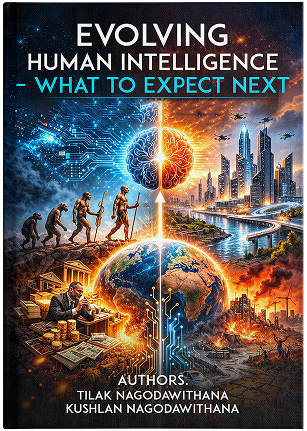
Exploring the Past, Understanding the Present
Shaping the Future
The world is changing faster than ever, raising important questions about learning, innovation, and the future of humanity. Evolving Human Intelligence: What to Expect Next takes readers on an engaging journey through the evolution of intelligence, the rise of artificial intelligence, and the ideas that may shape our future. Discover the connections between science, society, and the human mind in a way that is both informative and accessible.
About The Author
Behind this book are two visionary thinkers, Tilak Nagodawithana and Kushlan Nagodawithana. Their research-driven approach explores intelligence, evolution, and the impact of AI on human life.
I’M Tilak Nagodawithana and Kushlan Nagodawithana
For Dr. Tilak Nagodawithana and Kushlan Nagodawithana, this book began with a shared curiosity about how human thinking has evolved over time. Both have spent years observing how people learn, adapt, and make sense of a world that is constantly changing. That curiosity slowly turned into a deeper exploration of intelligence itself, what shapes it, how it grows, and where it might be heading in the future.
Their work brings together different fields of understanding, from science and technology to human behavior and society. Instead of looking at these subjects in isolation, they connect the dots between them. This approach helps readers see intelligence not just as something we measure, but as something that influences every part of life, from education and innovation to leadership and decision-making in the real world.
About The Book
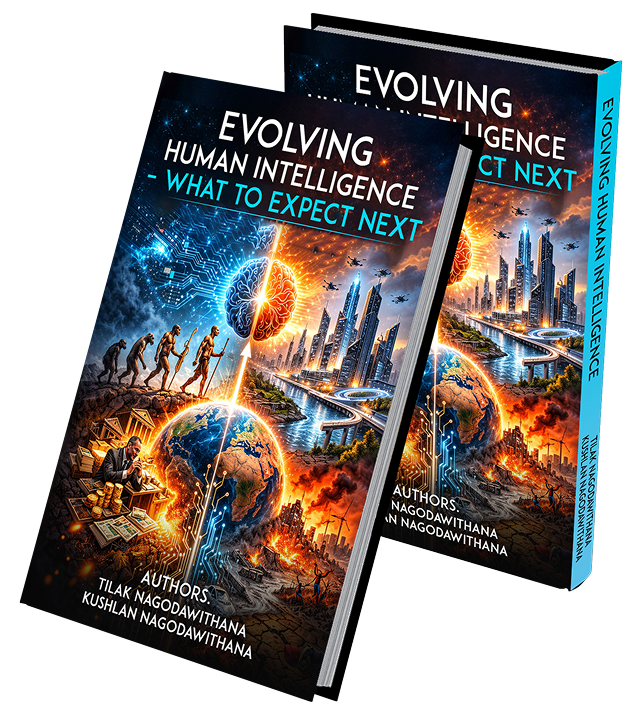
This book takes you on a journey into the nature of intelligence, how it begins, develops, and transforms over time. It connects human biology, innovation, and AI to reveal the next stage of human evolution.
Evolving Human Intelligence
What to Expect Next
Evolving Human Intelligence: What to Expect Next explores the fascinating journey of how human intelligence has developed over time and what it means for our future. From early evolutionary roots to modern scientific breakthroughs, the book connects science, learning, and human experience in a way that feels both meaningful and easy to follow. It helps readers see intelligence not just as a trait, but as a constantly evolving force shaping our world.
In a time where artificial intelligence is becoming part of everyday life, this book offers a grounded perspective on how human thinking, creativity, and decision-making still remain central to progress. It takes a closer look at how technology, genetics, education, and environment all work together in shaping who we are and what we can become.
- Evolution of human intelligence
- Impact on society
- Education and discipline
- Protecting the planet
What Our Readers Say
From science to philosophy, readers share how this book changed the way they see human evolution and the rise of artificial intelligence.
This book makes complex ideas feel simple and meaningful. The way it explains human intelligence and AI is both insightful and eye-opening.

Emily Watson
A fascinating read that connects science, technology, and human thought in a way that actually feels easy to understand. It really changed how I look at intelligence and the future

James Carter
What I loved most was how clearly it explained artificial intelligence and human intelligence side by side. Very thought-provoking and relevant to today’s world.

Michael Anderson
A well-written and accessible guide to understanding intelligence. It connects history, science, and future technology in a very smooth way.

Sarah Mitchell
This book opens your mind. It helps you understand not just how intelligence works, but how it continues to evolve with technology and society.

David Thompson
I found this book incredibly insightful. It breaks down complex ideas like genetics, learning, and AI into something everyone can relate to

Olivia Brown
Let’s Connect And Get Started
Ready to explore the future of human intelligence? Let’s connect and take the first step together toward insight and discovery.