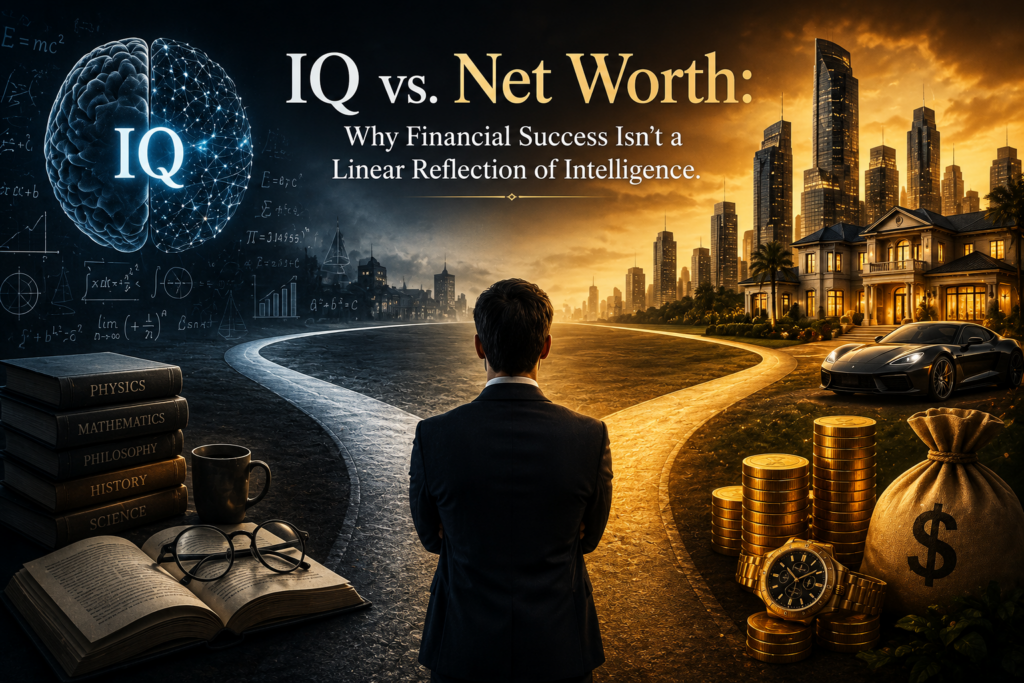
We tend to assume that smarter people naturally end up richer. It sounds logical that higher intelligence should equal better decisions, better careers, and ultimately, higher income. But reality tells a very different story. Across societies, some of the most intellectually gifted individuals live modest lives, while others with average academic performance build extraordinary wealth. This disconnect raises a deeper question: If intelligence is measurable, why isn’t success predictable?
The answer lies in how intelligence and wealth are distributed and why they follow completely different rules.
The Two Worlds: IQ vs Wealth Distribution
Human intelligence, when measured through IQ, generally follows a normal distribution. Most people cluster around the average, with fewer individuals at the extreme high or low ends. It forms a predictable bell curve. Wealth, however, does not behave this way.
Instead, it follows a Pareto distribution, often described as the “80/20 rule,” where a small percentage of people control a large portion of global wealth. In many cases, the top 1% holds disproportionate financial power compared to the rest of the population.
This mismatch creates a striking reality:
Intelligence is evenly spread. Wealth is not.
Why Intelligence Alone Doesn’t Guarantee Wealth
The book Evolving Human Intelligence: What to Expect Next highlights a crucial idea: intelligence is only one variable in a much larger system that shapes financial success.
Wealth creation depends on a complex mix of factors:
1. Environment Shapes Opportunity
A highly intelligent person in a limited environment may never get access to capital, mentorship, or platforms needed to scale their ideas. Meanwhile, someone in a resource-rich ecosystem may gain financial success simply through exposure and timing.
2. Luck and Timing Matter More Than We Admit
Markets, industries, and technologies shift rapidly. Being early in the right space, sometimes by chance, can matter more than raw cognitive ability. A good idea at the wrong time often fails. A decent idea at the right time can explode.
3. Risk Appetite Creates Financial Divergence
Intelligence often improves caution and analysis. Wealth creation, however, frequently rewards those willing to take bold, uncertain risks.
This creates an unexpected paradox:
Over-analysis can sometimes limit financial acceleration.
4. Systems Favor Compounding, Not Just Intelligence
Wealth tends to grow through compounding systems, investments, ownership, scalability, and networks. Intelligence helps build these systems, but it does not automatically place someone inside them.
Greed, Systems, and Structural Reality
Another important layer discussed in the book is how modern capitalism amplifies inequality through compounding advantages.
Wealth doesn’t just reflect intelligence; it reflects:
- access to capital
- early system entry
- ownership structures
- and sometimes, aggressive accumulation behavior
This is where intelligence and morality begin to separate. Financial systems often reward outcomes, not intent or fairness.
The Real Insight: Intelligence Is Potential, Not Outcome
Perhaps the most important takeaway is this:
Intelligence is the capacity to solve problems. Wealth is a result of solving problems within specific systems. They are connected but not causally aligned. A person may be highly intelligent in biology, engineering, or philosophy, but unless that intelligence interacts with the right system at the right time, it may never translate into financial success.
Rethinking Success in a Modern World
If IQ does not guarantee wealth, then what should we measure success by?
The book encourages a shift in perspective:
from pure financial achievement to impact, adaptability, and long-term contribution. Because intelligence, when aligned with opportunity and ethical systems, does far more than generate wealth, it shapes civilization itself.
Final Thought
The gap between IQ and net worth is not a flaw in intelligence; it is a reflection of how complex human systems truly are. Understanding this gap helps us move beyond simplistic beliefs about success and failure.
And it raises a more meaningful question:
If intelligence doesn’t guarantee wealth, then what kind of intelligence should we be developing for the future?