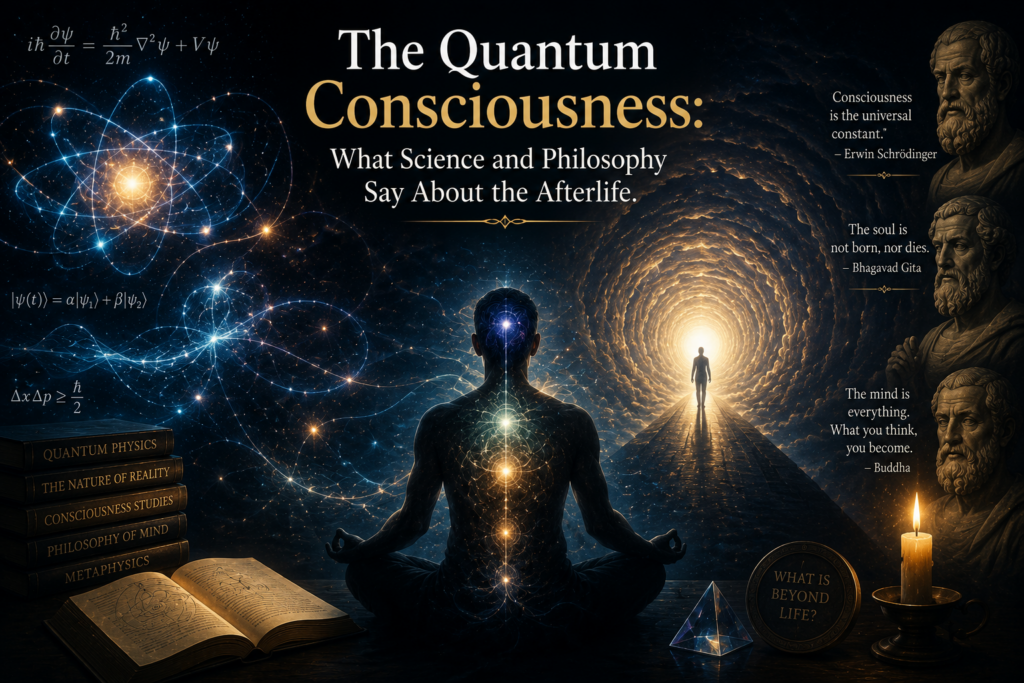
Human intelligence has evolved over millions of years, allowing us to understand the natural world, develop advanced technologies, and explore the deepest mysteries of existence. Yet one question continues to challenge both science and philosophy: What happens to consciousness after death?
In Evolving Human Intelligence: What to Expect Next, authors Kushlan Nagodawithana and Tilak Nagodawithana examine this fascinating subject by exploring modern neuroscience, quantum theories of consciousness, and philosophical perspectives that attempt to explain the nature of human awareness. Their discussion highlights how the study of consciousness may represent one of the next frontiers in humanity’s intellectual evolution.
The Mystery of Consciousness
Despite remarkable advances in neuroscience, scientists still cannot fully explain how consciousness emerges from the brain. We understand many of the biological processes involved in memory, perception, and decision-making, but the experience of being aware remains difficult to define.
This challenge becomes even more profound when considering death. If consciousness is simply a product of brain activity, it should cease entirely when the brain stops functioning. However, emerging research has introduced new questions that continue to fuel scientific debate.
What Happens in the Moments After Death?
One of the most intriguing areas of research involves the brief period following clinical death.
Studies have reported bursts of neurological activity occurring during the transition between life and death. Some researchers believe these surges may be linked to memory retrieval, awareness, or other cognitive processes taking place during the brain’s final moments.
While these findings do not prove the existence of an afterlife, they suggest that the process of dying may be more complex than previously understood. The book explores how these discoveries challenge conventional assumptions and encourage deeper investigation into the relationship between the brain and consciousness.
The Orch OR Theory and Quantum Consciousness
Among the most controversial and fascinating theories discussed in the book is the Orch OR (Orchestrated Objective Reduction) framework.
This theory proposes that consciousness may originate from quantum computations occurring within microscopic structures called microtubules inside brain cells. Rather than viewing consciousness solely as the result of electrical signals between neurons, Orch OR suggests that quantum processes may play a role in generating awareness.
If this theory proves correct, consciousness could be connected to fundamental aspects of reality that extend beyond traditional neurological explanations. Although many scientists remain skeptical, the theory continues to inspire research into the possible links between quantum physics and human cognition.
Panpsychism: An Ancient Idea Revisited
The book also examines panpsychism, a philosophical perspective with roots stretching back thousands of years.
Panpsychism proposes that consciousness is not limited to humans or even living organisms. Instead, it suggests that some form of awareness may exist throughout the universe as a fundamental property of reality. While this concept may appear unconventional, it has attracted renewed interest among philosophers and scientists seeking answers to the so-called “hard problem” of consciousness, understanding how subjective experience emerges from physical matter.
By revisiting ancient ideas through a modern scientific lens, researchers are opening new pathways for understanding the nature of existence itself.
Where Science Meets Philosophy
The search for answers about consciousness demonstrates the growing intersection between science and philosophy. Neuroscience provides valuable insights into brain function, while quantum theory and philosophical inquiry push the boundaries of what we currently know.
As human intelligence continues to evolve, so too does our ability to explore questions once considered beyond scientific investigation. The mystery of consciousness challenges us to remain open-minded while maintaining rigorous scientific standards.
Looking Toward Humanity’s Next Intellectual Frontier
The exploration of consciousness is about more than understanding death. It is about understanding life, awareness, and what it means to be human. In Evolving Human Intelligence: What to Expect Next, the authors argue that humanity’s future may depend not only on technological advancement but also on our willingness to investigate the deepest questions of existence. As research into consciousness expands, we may discover that the greatest mystery is not what lies beyond death, but the true nature of awareness itself.
To explore these thought-provoking ideas in greater depth, readers can dive into Evolving Human Intelligence: What to Expect Next and discover how the evolution of intelligence may shape humanity’s understanding of consciousness, reality, and the future.