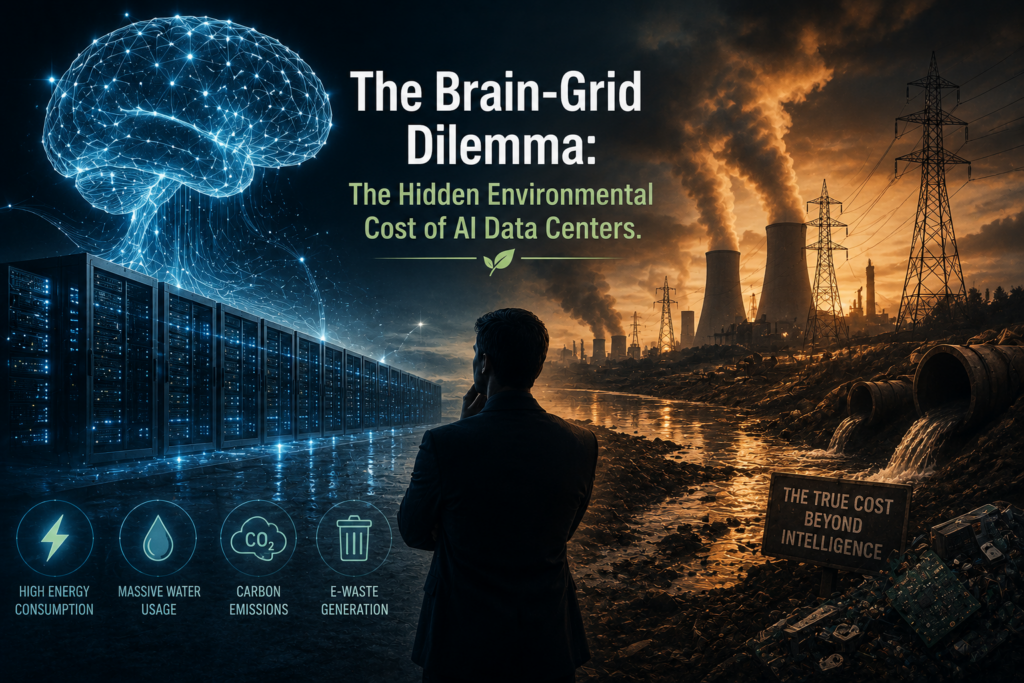
Artificial intelligence is changing the way we live, work, and communicate. From personalized recommendations on streaming platforms to advanced medical diagnostics, AI has quickly become one of the defining technologies of the modern era. Yet while most discussions focus on what AI can do, far fewer explore what it takes to keep AI running.
Behind every chatbot response, image generator, and machine-learning model lies a vast physical infrastructure that consumes enormous amounts of energy. As AI continues to grow, so does the demand for the data centers that power it. This raises an important question: Are we paying enough attention to the environmental cost of artificial intelligence?
The Digital World Has a Physical Footprint
Many people think of AI as something that exists entirely online. In reality, AI depends on massive networks of computers housed in specialized facilities known as data centers. These facilities store information, process requests, train machine-learning models, and deliver results in real time. The more advanced AI becomes, the greater the computing power required to support it.
What often goes unnoticed is that these operations require significant amounts of electricity. Thousands of servers running continuously generate large quantities of heat, making cooling systems essential for maintaining performance and preventing equipment failure. As AI adoption expands, so does the energy required to support it.
Why Energy Consumption Matters
The rapid growth of AI is creating new demands on power infrastructure around the world. Data centers already rank among the largest consumers of electricity in many regions. As companies race to develop more sophisticated AI systems, additional facilities are being built to handle increasing workloads.
This growing demand places pressure on electrical grids that are already serving homes, businesses, hospitals, and public services. In areas where energy resources are limited, concerns about long-term sustainability are becoming more difficult to ignore. The challenge is not simply about powering technology. It is about determining how resources should be managed in a world where digital growth continues to accelerate.
The Water Problem Few People Talk About
Electricity is only part of the equation. Many large data centers rely on extensive cooling systems that require substantial amounts of water. This is particularly concerning in regions that already face water shortages or seasonal drought conditions. As communities become more aware of how much water modern computing infrastructure consumes, debates surrounding environmental responsibility are becoming increasingly common.
Residents often question whether local resources should be stretched further to accommodate expanding technology projects. These discussions highlight the growing tension between innovation and environmental stewardship.
Can Technology Solve Its Own Problem?
The technology industry is aware of these concerns and is actively searching for solutions. Engineers are developing more efficient processors capable of delivering greater performance while using less energy. New generations of AI hardware are being designed to reduce heat production and improve cooling efficiency.
Advances in data center architecture are also helping operators lower resource consumption without sacrificing computational power. While these improvements are encouraging, efficiency alone may not be enough. As AI capabilities increase, demand for processing power continues to grow as well. The real challenge lies in ensuring that sustainability keeps pace with innovation.
The Responsibility That Comes With Intelligence
Human progress has always been driven by the desire to solve problems and push boundaries. Artificial intelligence is the latest chapter in that story. However, intelligence is not only about creating powerful tools. It is also about understanding their consequences.
The environmental questions surrounding AI remind us that every technological breakthrough carries responsibilities. Decisions made today will influence not only the future of computing but also the health of communities and ecosystems around the world. Balancing technological advancement with environmental accountability may become one of the defining challenges of the coming decades.
Looking Beyond the Technology
One of the most thought-provoking ideas explored in Evolving Human Intelligence: What to Expect Next is that intelligence should be measured not only by innovation but also by wisdom. As society embraces increasingly powerful technologies, success will depend on more than computational capability. It will depend on humanity’s ability to make thoughtful choices about how those technologies are developed, deployed, and sustained.
The future of AI is not just a story about machines becoming smarter. It is also a story about whether humans can use their own intelligence responsibly.
Final Thoughts
Artificial intelligence has the potential to improve lives, accelerate discovery, and transform industries. At the same time, its growing environmental footprint deserves careful attention. Understanding the hidden costs of AI does not mean rejecting progress. Instead, it encourages a broader conversation about sustainability, responsibility, and the kind of future we want to build.
For readers interested in exploring these questions in greater depth, Evolving Human Intelligence: What to Expect Next offers a fascinating look at the relationship between human evolution, technology, ethics, and the future of civilization.
What role should environmental responsibility play in the future development of AI?