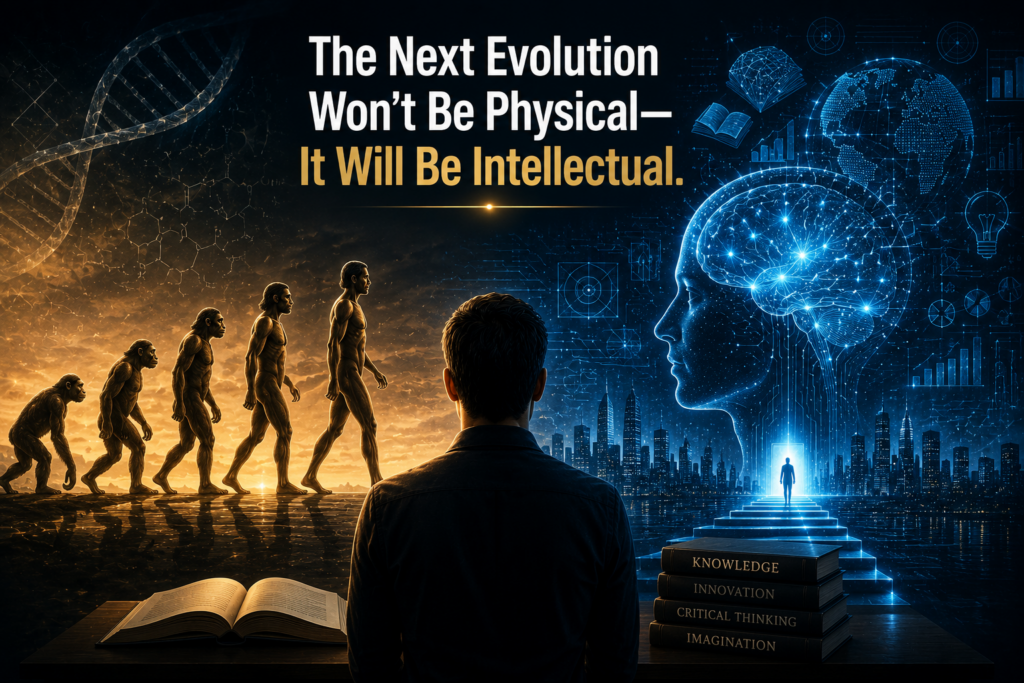
For centuries, human evolution has been associated with physical change. We imagine our ancestors adapting to harsh environments, developing new survival skills, and gradually becoming the species we are today. But what if the next great leap in evolution looks nothing like the last?
What if the future of humanity depends less on our bodies and more on how we use our intelligence?
As technology accelerates and artificial intelligence becomes woven into daily life, we are entering an era that demands a new kind of evolution, one centered on wisdom, responsibility, and intellectual growth.
How We Got Here
Human intelligence did not appear overnight. It emerged through millions of years of adaptation, problem-solving, and learning. Early humans survived because they could recognize patterns, communicate ideas, and create tools that improved their chances of survival. Over time, those abilities expanded into science, medicine, engineering, and technology. Every generation built upon the discoveries of the previous one.
Today, that long evolutionary journey has produced one of humanity’s most powerful creations: artificial intelligence.
AI can analyze data, recognize patterns, and perform tasks at remarkable speed. In many ways, it reflects humanity’s desire to understand and replicate intelligence itself. But creating intelligent machines raises an important question: Are we prepared for the consequences?
Intelligence Without Wisdom Can Be Dangerous
History has shown that innovation alone does not guarantee progress. Technological breakthroughs have improved lives, but they have also created new challenges. The same intelligence that develops life-saving medical treatments can also be used to exploit resources, widen economic inequality, or prioritize profit over people. This is why the future depends on more than intelligence alone.
Wisdom is the ability to consider long-term consequences. It is the capacity to balance innovation with ethics and progress with responsibility. As AI continues to evolve, society must ask not only what technology can do, but what it should do.
The Human Qualities Machines Cannot Replicate
Artificial intelligence excels at processing information, but human intelligence extends beyond calculations and predictions. People possess empathy, moral judgment, creativity, and self-awareness. These qualities influence how we build relationships, make decisions, and shape communities.
A machine may generate an answer, but it cannot fully understand the emotional impact of that answer on another human being. This distinction is crucial as automation expands across industries. The most valuable human skills may soon be the ones that technology struggles to imitate.
A New Responsibility for Future Generations
The coming decades will require individuals to adapt faster than ever before. Learning can no longer end with formal education. Curiosity, flexibility, and critical thinking will become essential lifelong skills. Future leaders will need to understand not only technology but also human behavior, ethics, and social responsibility.
The goal should not be to compete with machines. The goal should be to develop the uniquely human qualities that allow us to guide technology in ways that benefit society.
Looking Ahead
Humanity stands at a remarkable crossroads. We have created tools powerful enough to transform nearly every aspect of life. Whether those tools improve the future or create new challenges depends on the choices we make today. The next stage of evolution may not involve stronger bodies or larger brains. Instead, it may depend on our ability to use intelligence responsibly, think beyond short-term gains, and place human values at the center of technological progress.
These thought-provoking questions lie at the heart of Evolving Human Intelligence: What to Expect Next, a book that explores the origins of intelligence, the rise of artificial intelligence, and the future path of human civilization.
How do you think humanity should balance technological advancement with ethical responsibility? Share your thoughts and join the conversation. To explore these ideas in greater depth, discover Evolving Human Intelligence: What to Expect Next, and examine what the future may hold for both human and artificial intelligence.